
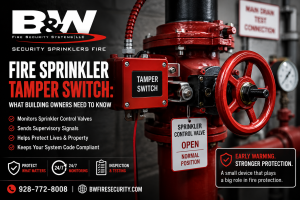
What Is a Fire Sprinkler Tamper Switch, and Why Is It Important?
A fire sprinkler system depends on an available water supply to control or suppress a fire. Even a properly designed sprinkler system cannot operate as intended when its main control valve is closed.
That is where a fire sprinkler tamper switch becomes important.
A tamper switch monitors the position of a fire sprinkler control valve. When someone begins closing the valve or moves it away from its normal operating position, the switch sends a supervisory signal to the building’s fire alarm system.
According to the National Fire Protection Association’s guide to sprinkler supervision, electrical supervision helps ensure that abnormal sprinkler-system conditions are reported either to qualified personnel in the building or to an approved remote receiving facility.
For business owners, property managers, and facility personnel, understanding these signals can help prevent sprinkler system failures, fire inspection violations, and potentially serious property losses.
B&W Fire Security Systems installs, inspects, tests, monitors, and services fire protection systems throughout Prescott Valley, Prescott, Chino Valley, Sedona, Flagstaff, Camp Verde, Cottonwood, and surrounding Northern Arizona communities.
What Is a Fire Sprinkler Tamper Switch?
A fire sprinkler tamper switch is an electronic monitoring device attached to a sprinkler system control valve.
Its purpose is to detect when the valve has moved from its normal position.
Most sprinkler control valves must remain fully open so that water can reach the sprinkler piping. When a valve is partially or completely closed, water flow may be restricted or stopped.
The tamper switch helps alert responsible personnel before this condition goes unnoticed.
Depending on the system, the supervisory signal may appear:
- At the fire alarm control panel
- At a remote annunciator
- On a monitoring center operator’s screen
- Through an email, text, or mobile notification
- On an integrated building management system
The switch does not physically prevent someone from closing the valve. Instead, it provides an early warning that the sprinkler system’s water supply may have been affected.
The NFPA’s explanation of sprinkler valve supervision describes an electronically monitored tamper switch as one of the most common devices used to supervise sprinkler control valves.
Why Is a Fire Sprinkler Tamper Switch Necessary?
A closed sprinkler valve can leave an entire building—or a large section of it—without automatic sprinkler protection.
Control valves can be closed for several reasons:
- Sprinkler system repairs
- Accidental contact or adjustment
- Unauthorized tampering
- Construction work
- Leak investigation
- System maintenance
- Failure to reopen a valve after service
Without valve supervision, the closed valve might remain unnoticed for days, weeks, or even months.
The problem may not be discovered until an inspection occurs or, in the worst situation, until a fire activates a sprinkler head and no water reaches it.
A properly operating tamper switch helps building personnel identify the condition quickly so that the valve can be investigated and the system restored by qualified professionals.
The Occupational Safety and Health Administration’s automatic sprinkler system standard addresses the maintenance and reliability of workplace sprinkler systems. OSHA also defines inspection as checking fire protection equipment to confirm that it is in place, charged, and ready for use.
What Is a Fire Sprinkler Supervisory Signal?
A supervisory signal indicates that a monitored fire protection condition requires attention.
It is different from both an alarm signal and a trouble signal. The NFPA’s guide to fire alarm supervision explains how supervision helps monitor the status of connected fire protection equipment and systems.
Fire Alarm Signal
A fire alarm signal indicates that the system has detected a possible fire-related event. It may be caused by:
- Smoke detection
- Heat detection
- Manual pull-station activation
- Sprinkler water flow
- Another fire-initiating device
Occupants should follow the building’s emergency procedures whenever a fire alarm activates.
Supervisory Signal
A supervisory signal indicates that a monitored component of the fire protection system is in an abnormal position or condition.
Common examples include:
- A sprinkler control valve being moved
- Low air pressure in a dry sprinkler system
- Low water temperature
- Fire pump conditions
- Low tank water levels
- Certain fire-suppression system conditions
A supervisory signal may not mean there is an active fire, but it should never be ignored.
Trouble Signal
A trouble signal normally indicates a fault affecting the fire alarm system itself.
Examples can include:
- Loss of primary electrical power
- Low backup batteries
- Damaged wiring
- Communication failure
- Device failure
- Ground faults
- Disabled circuits or zones
Alarm, supervisory, and trouble signals have different meanings and require different responses. Building personnel should be trained to recognize each condition.
The NFPA’s fire alarm basics guide provides additional information about the major functions and components of fire alarm systems.
How Does a Tamper Switch Work?
The exact operation depends on the type of sprinkler valve and switch being used.
In general, the switch monitors the mechanical position of the valve.
When the valve begins moving away from its normal fully open position, the tamper switch changes electrical state. That change is recognized by the fire alarm control panel as a supervisory condition.
The panel may then:
- Sound a local supervisory buzzer.
- Display the affected device or sprinkler valve.
- Illuminate a supervisory indicator.
- Send a signal to the monitoring center.
- Notify the building’s designated emergency contacts.
The display might identify the affected location with wording such as:
- Sprinkler Valve Tamper
- Riser Valve Supervisory
- PIV Tamper
- OS&Y Valve Tamper
- Control Valve Off Normal
- Sprinkler Supervisory
The exact wording depends on the system’s programming and the type of fire alarm panel installed.
Common Types of Fire Sprinkler Tamper Switches
Different control valves require different supervisory devices.
OS&Y Valve Tamper Switch
An outside screw and yoke valve, commonly called an OS&Y valve, uses a threaded stem that visibly moves as the valve opens or closes.
A tamper switch is positioned to monitor this movement.
OS&Y valves are commonly found near sprinkler risers, backflow assemblies, fire pumps, and water-supply connections.
Butterfly Valve Tamper Switch
Butterfly valves are compact control valves frequently used on commercial sprinkler systems.
Many butterfly valves include a built-in supervisory switch. The switch monitors the valve’s internal position and sends a signal when the valve moves away from fully open.
Post Indicator Valve Tamper Switch
A post indicator valve, or PIV, is often located outside the building and controls the water supply entering the fire sprinkler system.
The valve usually includes a visible indicator showing whether it is open or shut.
A supervisory switch may be installed to monitor the valve’s position and report unauthorized or accidental closure.
Wall Post Indicator Valve Switch
A wall post indicator valve operates similarly to a standard PIV but is mounted through an exterior wall.
It can also be supervised to help ensure that the sprinkler water supply remains available.
Floor Control Valve Assembly
Some multistory buildings have a separate control valve assembly for each floor. These assemblies may include a control valve, check valve, pressure gauge, drain valve, flow switch, and supervisory equipment.
The NFPA’s floor control valve assembly guide explains how these assemblies allow individual floors or areas to be controlled and monitored.
What Causes a Valve Tamper Signal?
A tamper signal is often caused by a sprinkler control valve being partially or fully closed.
However, several other conditions may also trigger the signal.
Someone Moved the Valve
A technician, employee, contractor, or unauthorized person may have adjusted the valve.
Even a small movement can activate some switches.
The Valve Was Not Fully Reopened
After maintenance, testing, or repairs, the valve may have been left partially closed.
This is one reason contractors must follow proper restoration procedures after completing sprinkler work.
The Tamper Switch Is Misaligned
A switch that has shifted from its correct position may activate even when the valve appears open.
The device may require adjustment or replacement by a qualified fire protection technician.
Damaged Wiring
Loose, corroded, cut, or damaged wiring can affect communication between the tamper switch and the fire alarm control panel.
Depending on the system design, this condition may generate either a supervisory or trouble signal.
The Switch Has Failed
Tamper switches are mechanical and electrical devices. They can wear out, become damaged, or fail over time.
Construction or Maintenance Activity
Work near a sprinkler riser, control valve, backflow assembly, or exterior PIV may accidentally disturb the valve or switch.
Contractors working near fire protection equipment should be informed that these components must not be moved, obstructed, painted, disconnected, or altered.
What Should You Do When a Tamper Signal Appears?
A sprinkler supervisory signal should be investigated promptly.
1. Read the Fire Alarm Panel Display
The fire alarm control panel may identify the affected valve or area.
Write down the complete message before pressing any panel controls.
2. Contact the Monitoring Center
For a monitored system, determine whether the monitoring center received the supervisory signal.
Follow the communication and notification procedures established for your property.
3. Check for an Actual Emergency
Look and listen for signs of smoke, fire, water flow, leaking pipes, or sprinkler activation.
When there is any indication of a fire, evacuate the building and call 911.
Do not assume that a supervisory signal is harmless.
4. Check for Scheduled Work
Determine whether a sprinkler contractor, plumber, maintenance employee, or construction crew is working on the system.
The valve may have been intentionally closed as part of an approved service procedure.
5. Contact a Qualified Fire Protection Company
The condition should be evaluated by someone who understands both the fire sprinkler and fire alarm systems.
Do not repeatedly reset or silence the panel without identifying and correcting the cause.
6. Document the Condition
Record:
- The time the signal occurred
- The complete panel message
- The affected area
- Who was contacted
- What caused the signal
- When the system was restored
- Who completed the repair or service
Good documentation can be useful during future inspections and compliance reviews.
Can You Simply Reset a Valve Tamper Signal?
Resetting the fire alarm panel without correcting the valve condition will usually not solve the problem.
The supervisory signal may immediately return because the switch still detects an abnormal valve position.
The correct response normally requires:
- Identifying the affected valve.
- Determining why it moved.
- Confirming whether the sprinkler system is impaired.
- Returning the valve to its required position when authorized.
- Inspecting the switch and wiring.
- Restoring the fire alarm panel.
- Confirming signal transmission with the monitoring center.
- Documenting the completed work.
Only trained and authorized personnel should operate sprinkler control valves.
Improper valve operation can create leaks, pressure changes, false water-flow alarms, or an unprotected building.
Does a Tamper Signal Mean the Sprinkler System Is Completely Disabled?
Not always.
The signal means that a monitored valve or related condition requires investigation. The amount of affected sprinkler coverage depends on which valve moved and how the building’s system is arranged.
A valve might control:
- The entire building
- One floor
- One tenant space
- One sprinkler riser
- A specific hazard area
- A fire-pump connection
- An underground water supply
- A separate dry, preaction, or wet sprinkler system
Because the extent of the impairment may not be obvious, the condition should be evaluated promptly.
Depending on the situation and local requirements, the property owner may need to notify the monitoring provider, fire department, insurance carrier, property management company, or other responsible parties.
A fire watch may also be required when a fire protection system is significantly impaired. The local Authority Having Jurisdiction determines the applicable requirements.
Why Fire Sprinkler Tamper Switch Testing Matters
A tamper switch only provides protection when it is installed, connected, programmed, and operating correctly.
During professional testing, technicians may verify that:
- The valve is accessible
- The valve is properly identified
- The switch is securely mounted
- The device activates as required
- The fire alarm panel receives the correct supervisory signal
- The monitoring center receives the signal
- The panel displays the proper valve location
- The signal clears after restoration
- Wiring and connections are in acceptable condition
Testing may reveal problems such as:
- Incorrect panel descriptions
- Failed switches
- Loose mounting hardware
- Missing supervision
- Damaged wiring
- Signals that do not reach the monitoring center
- Valves that do not operate correctly
- Supervisory signals incorrectly programmed as trouble signals
The NFPA explains that NFPA 25 establishes inspection, testing, and maintenance requirements for water-based fire protection systems.
The NFPA also provides a helpful overview of sprinkler inspection, testing, and maintenance frequencies.
Required frequencies can vary according to the component, system type, adopted code edition, manufacturer instructions, and requirements of the local Authority Having Jurisdiction.
Common Fire Sprinkler Valve Violations
Sprinkler control valves are frequently reviewed during fire inspections.
Potential deficiencies include:
- A valve left partially closed
- A valve that is not properly supervised
- A missing lock or seal where required
- An inaccessible or obstructed valve
- Missing identification signs
- A painted or damaged tamper switch
- Exposed or damaged wiring
- Incorrect fire alarm panel descriptions
- A supervisory signal that does not transmit
- Storage blocking access to the sprinkler riser
- A closed valve with no impairment documentation
- An unresolved supervisory condition
These issues can often be prevented through routine visual checks and professional sprinkler inspections.
OSHA’s fire safety standards and resources provide additional information for employers about workplace fire protection requirements.
How Building Owners Can Prevent Tamper Switch Problems
Property owners and managers can take several practical steps.
Keep Sprinkler Valves Accessible
Do not store boxes, furniture, equipment, or supplies in front of sprinkler risers and control valves.
Technicians and emergency personnel must be able to reach the equipment.
Restrict Unauthorized Access
Sprinkler riser rooms should remain secure while still being accessible to authorized personnel and emergency responders.
Train Employees
Employees should understand that sprinkler valves must not be operated without authorization.
They should also know who to contact when the fire alarm panel displays a supervisory signal.
Coordinate Contractor Work
Inform contractors when they are working near fire sprinkler or fire alarm equipment.
Any planned sprinkler shutdown should be coordinated with the building owner, monitoring center, fire protection provider, and local authorities when required.
Review the Fire Alarm Panel Regularly
The fire alarm panel should normally display a normal condition.
A supervisory or trouble indicator should not be ignored simply because the audible buzzer has been silenced.
Schedule Professional Inspections
Routine inspection, testing, and maintenance help confirm that valves, supervisory switches, alarm panels, and monitoring connections work together properly.
The U.S. Fire Administration also provides educational resources about fire prevention, sprinkler systems, code enforcement, and community fire safety.
Fire Sprinkler Tamper Switches and 24/7 Monitoring
A monitored tamper switch provides additional protection when a building is vacant or responsible personnel are not near the fire alarm panel.
When a valve moves, the monitoring center may receive the supervisory signal and notify the property’s designated contacts.
This can be especially valuable for:
- Commercial buildings
- Warehouses
- Apartment complexes
- Schools
- Medical facilities
- Hotels
- Restaurants
- Industrial properties
- Seasonal businesses
- Remote Northern Arizona properties
Monitoring does not replace inspection, testing, or maintenance. It provides an additional layer of notification when an abnormal condition occurs.
Learn more about B&W Fire Security’s 24/7 fire and security monitoring.
Fire Sprinkler Service in Northern Arizona
A fire sprinkler tamper switch may be small, but it performs an important role.
It helps ensure that sprinkler control valves remain in the correct position and alerts responsible personnel when the building’s water-based fire protection may be compromised.
B&W Fire Security Systems provides complete fire protection services throughout Northern Arizona, including:
- Fire sprinkler inspections
- Sprinkler system testing
- Sprinkler repairs and maintenance
- Fire alarm inspections
- Fire alarm monitoring
- Supervisory device testing
- Fire sprinkler installation
- Backflow testing
- Fire extinguisher inspections
- Commercial fire code compliance assistance
Our team serves businesses and property owners throughout Prescott Valley, Prescott, Chino Valley, Sedona, Cottonwood, Camp Verde, Flagstaff, and surrounding communities.
Learn more about our fire sprinkler services or contact B&W Fire Security Systems to schedule service.
Call 928-772-8008 to request an inspection, repair, or fire protection evaluation.
Frequently Asked Questions About Fire Sprinkler Tamper Switches
What does a sprinkler tamper switch do?
A sprinkler tamper switch monitors the position of a sprinkler control valve. It sends a supervisory signal when the valve moves away from its normal position.
Is a tamper signal the same as a fire alarm?
No. A fire alarm indicates a potential fire-related event. A tamper signal is normally a supervisory condition indicating that a sprinkler valve or monitored fire protection component requires attention.
Will the fire department respond to a valve tamper signal?
Response procedures vary by jurisdiction, system configuration, and monitoring provider. The monitoring center generally follows the notification instructions established for the property.
Why does my fire alarm panel say supervisory?
A supervisory message may indicate an abnormal sprinkler valve position, low air pressure, low water level, temperature condition, or another monitored fire protection issue. Read the complete panel message and contact a qualified service provider.
Can a building employee reopen a closed sprinkler valve?
Only trained and authorized personnel should operate fire sprinkler control valves. The reason for the closure must be identified before the valve is moved. Opening a valve without understanding the condition could cause water damage or other system problems.
How often should tamper switches be tested?
The required testing frequency depends on the system, device, adopted codes, manufacturer instructions, and local Authority Having Jurisdiction. A qualified fire protection company can establish the proper inspection and testing schedule for your property.
Can a faulty tamper switch cause repeated supervisory signals?
Yes. Misalignment, damaged wiring, loose mounting, valve movement, corrosion, or switch failure can cause recurring signals. The cause should be professionally diagnosed rather than repeatedly resetting the panel.
Who repairs fire sprinkler tamper switches?
Tamper switches should be inspected and repaired by a qualified fire protection provider familiar with both sprinkler and fire alarm systems.
External Fire Protection Resources
For more information about fire sprinkler systems, maintenance, workplace safety, and supervisory signals, visit:
- NFPA: What Is Sprinkler Supervision?
- NFPA: Fire Alarm System Supervision
- NFPA: Maintaining a Sprinkler System Under NFPA 25
- NFPA: Sprinkler Inspection and Testing Frequencies
- OSHA: Automatic Sprinkler System Requirements
- OSHA: Workplace Fire Safety Standards
- U.S. Fire Administration: Fire Safety Resources