
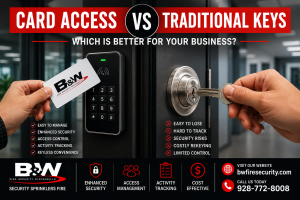
Card Access vs. Traditional Keys: Which Security Solution Is Best for Your Business?
When it comes to protecting your business, controlling who can enter your facility is one of the most important security decisions you’ll make. Whether you operate an office building, warehouse, healthcare facility, school, or retail store, securing access points helps protect employees, customers, inventory, equipment, and sensitive information.
For years, businesses relied on traditional locks and keys. Today, however, more organizations are upgrading to modern access control systems that provide greater security, flexibility, and visibility.
But which option is right for your business?
Let’s compare traditional keys and card access systems to help you make an informed decision.
What Are Traditional Key Systems?
Traditional key systems use mechanical locks and physical keys to secure doors and restricted areas. While they remain a common solution, they offer limited security management capabilities.
Advantages of Traditional Keys
- Low initial cost
- Simple installation
- No software required
- No network connectivity needed
Disadvantages of Traditional Keys
- Keys can be lost or stolen
- Duplicate keys may be made without authorization
- No way to monitor who enters a building
- Rekeying can be costly
- Difficult to manage as businesses grow
For small businesses with limited security needs, traditional keys may still be sufficient. However, as organizations expand, key management often becomes more complicated and expensive.
What Is a Card Access Control System?
A card access control system replaces traditional keys with electronic credentials such as:
- Key cards
- Key fobs
- Mobile phone credentials
- PIN codes
- Biometric authentication
Instead of inserting a key into a lock, users present a credential to a reader. The system verifies permissions and grants access if authorized.
Many modern access control systems integrate with video surveillance systems, allowing businesses to monitor access events and improve overall security.
Card Access vs. Traditional Keys: Side-by-Side Comparison
| Feature | Traditional Keys | Card Access Systems |
|---|---|---|
| Security | Basic | Advanced |
| Lost Credential Management | Replace locks | Disable instantly |
| Activity Tracking | None | Complete audit trail |
| Remote Management | No | Yes |
| Employee Permissions | Limited | Fully customizable |
| Multi-Location Management | Difficult | Centralized |
| Scalability | Limited | Excellent |
| Integration With Security Systems | No | Yes |
For most commercial facilities, card access systems provide significantly greater control and accountability.
Security: Which Option Is Safer?
Security is often the primary reason businesses upgrade from traditional locks to electronic access control.
Risks Associated With Traditional Keys
When a key is lost or stolen, business owners face several concerns:
- Has the key been copied?
- Who currently has access?
- Should the locks be replaced?
In many cases, the only way to restore security is to rekey or replace the locks entirely.
The Cybersecurity & Infrastructure Security Agency (CISA) recommends implementing strong physical security measures to protect facilities from unauthorized access, theft, and security breaches.
Advantages of Card Access Systems
If a key card or credential is lost, administrators can immediately deactivate it without replacing locks.
Additional benefits include:
- Instant access revocation
- Real-time monitoring
- Custom access permissions
- Automated reporting
- Reduced security risks
This level of control makes electronic access control significantly more secure than traditional keys.
Employee Access Management Made Easy
As your business grows, managing employee access becomes increasingly important.
Different employees often require different levels of access:
- Warehouse personnel may need access to inventory areas.
- Accounting teams may require access to financial records.
- Managers may need unrestricted access throughout the building.
Traditional keys make this difficult to manage.
Card access systems allow administrators to customize permissions based on job role, department, schedule, and location.
Changes can be made instantly without distributing new keys or replacing locks.
The Occupational Safety and Health Administration (OSHA) recognizes access management and facility security as important components of workplace safety and violence prevention programs.
Accountability and Audit Trails
One of the greatest advantages of card access systems is visibility.
Traditional keys cannot answer questions such as:
- Who entered the building?
- When did they enter?
- Which doors were accessed?
Card access systems automatically create detailed logs that track every access event.
When integrated with commercial security systems, businesses gain valuable insights into facility activity and potential security incidents.
This information can be essential during investigations, compliance audits, and insurance claims.
Compliance and Risk Reduction
Many industries require organizations to maintain records of facility access.
Examples include:
- Healthcare
- Financial services
- Government facilities
- Educational institutions
- Data centers
Card access systems simplify compliance by automatically documenting access activity.
Businesses should also ensure their security systems comply with standards established by the National Fire Protection Association (NFPA), particularly when access control systems interact with emergency exits and fire safety equipment.
Integration With Modern Security Technology
Today’s security systems are most effective when they work together.
Modern access control systems can integrate with:
- Surveillance cameras
- Intrusion alarms
- Visitor management systems
- Intercom systems
- Fire Alarm Systems
For example, access events can automatically be linked to video footage, creating a complete security record.
According to security experts at ASIS International, integrated security platforms provide greater situational awareness and improve overall facility protection.
The Future of Access Control
The security industry continues to evolve rapidly.
Cloud-based access control, mobile credentials, touchless entry, and AI-powered monitoring are becoming standard features in modern commercial facilities.
The Security Industry Association (SIA) reports that cloud-managed access control solutions are among the fastest-growing segments of the commercial security market.
Businesses that invest in modern access control technology today position themselves for greater security and operational efficiency in the future.
Final Verdict: Card Access Is the Better Long-Term Investment
While traditional keys remain a familiar option, they cannot match the security, flexibility, scalability, and accountability offered by modern access control systems.
For businesses looking to:
- Improve security
- Reduce risk
- Simplify employee management
- Monitor facility activity
- Support future growth
Card access systems are typically the superior choice.
Secure Your Facility With B&W Fire Security Systems LLC
At B&W Fire Security Systems LLC, we provide advanced security solutions designed to protect businesses of all sizes.
Our services include:
Whether you’re replacing traditional locks or implementing a complete security upgrade, our team can help you choose the right solution for your business.
Contact B&W Fire Security Systems LLC today to schedule a consultation and learn how modern access control can strengthen your facility’s security.