
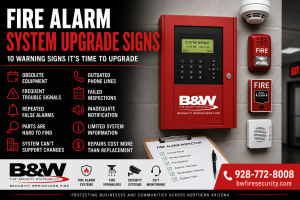
10 Fire Alarm System Upgrade Signs You Shouldn’t Ignore
A commercial fire alarm system is one of the most important life-safety systems in your building. It is designed to detect potential fire conditions, warn occupants and, when professionally monitored, transmit signals to an off-site monitoring center.
However, fire alarm systems do not last forever.
Equipment becomes obsolete, replacement parts become harder to find and buildings change over time. A system that worked well 15 or 20 years ago may no longer provide the reliability, coverage or communication capabilities your property needs today.
Recognizing the most common fire alarm system upgrade signs can help you address problems before they lead to repeated service calls, failed inspections or an unreliable system during an emergency.
Here are 10 warning signs that it may be time to have your commercial fire alarm system professionally evaluated.
1. Your Fire Alarm Equipment Is Obsolete
One of the clearest fire alarm system upgrade signs is obsolete equipment.
Fire alarm manufacturers periodically discontinue older panels, detectors, modules and communication devices. When this happens, replacement parts may become difficult or impossible to obtain.
An obsolete fire alarm system may still operate, but maintaining it can become increasingly challenging.
Warning signs include:
- Replacement parts are no longer manufactured
- Your service provider must search for used components
- Compatible smoke detectors are unavailable
- Manufacturer support has ended
- Programming software is no longer supported
- The panel cannot communicate with modern equipment
Using old or salvaged parts may temporarily restore operation, but it does not always provide a reliable long-term solution.
When critical components are no longer available, upgrading the system can be more practical than continuing to repair outdated equipment.
B&W Fire Security provides complete commercial fire alarm design, installation, inspection and monitoring services for businesses throughout Northern Arizona.
2. The System Has Frequent Trouble Signals
A fire alarm panel should not remain in a recurring trouble condition.
A trouble signal indicates that the system has detected a problem that may affect its operation. Some trouble conditions are minor and easily repaired, while others can indicate aging wiring, failing devices or communication problems.
Common trouble conditions include:
- Low backup batteries
- Ground faults
- Open or shorted circuits
- Communication failures
- Missing devices
- Power-supply problems
- Notification-appliance circuit faults
- Detector or module failures
A single trouble signal does not always mean the entire system must be replaced. However, repeated trouble conditions—especially when they involve different components—can indicate that the system is reaching the end of its practical service life.
Do not repeatedly silence or reset a trouble condition without identifying its cause.
The National Fire Protection Association publishes NFPA 72, which addresses the installation, inspection, testing and maintenance of fire alarm and signaling systems. The code edition enforced at your property depends on what has been adopted by the applicable jurisdiction.
3. You Are Experiencing Repeated False or Unwanted Alarms
Frequent false alarms are disruptive, expensive and dangerous.
When employees or occupants become accustomed to unwanted alarms, they may hesitate during a real emergency. False alarms can also interrupt business operations and may result in additional costs, depending on local policies.
Potential causes include:
- Dirty or aging smoke detectors
- Improper detector placement
- Dust from construction or manufacturing
- Steam or cooking activity
- Electrical problems
- Water damage
- Incorrect system programming
- Failing control-panel components
- Outdated detection technology
Some unwanted alarms can be corrected through cleaning, testing, relocation or device replacement.
However, if false alarms continue after repeated repairs, a system upgrade may provide more reliable detection and improved technology.
Modern addressable systems can often provide more detailed information about which device activated and where it is located.
Regular fire alarm inspections and testing can help identify damaged devices, communication failures and other deficiencies before they become larger problems.
4. Replacement Parts Are Difficult to Find
Even when a fire alarm panel is technically operational, maintenance becomes a problem when parts are scarce.
A simple repair can turn into a lengthy search for:
- Compatible smoke detectors
- Control modules
- Power supplies
- Annunciators
- Notification appliances
- Circuit boards
- Batteries
- Communication equipment
Limited parts availability can increase service costs and extend downtime.
It can also leave the building with an impaired or partially functioning system while components are located.
When parts are regularly unavailable, property owners should consider whether continuing to invest in an obsolete system makes financial sense.
A planned upgrade is usually easier to manage than an emergency replacement after a major component fails.
5. Your Fire Alarm Panel Cannot Support Building Changes
Buildings rarely remain exactly as they were when the original fire alarm system was installed.
Over time, property owners may:
- Add offices
- Remove walls
- Expand tenant spaces
- Remodel common areas
- Build additions
- Change occupancy types
- Install new equipment
- Add commercial kitchens
- Modify warehouse storage
- Add fire sprinkler systems
These changes may affect fire alarm coverage, notification requirements and panel capacity.
Older systems may have limited space for additional circuits, devices or control modules. In some cases, the panel may be operating at or near its maximum capacity.
A system upgrade may be needed if the existing panel cannot support the building’s current configuration or planned expansion.
Before beginning a tenant improvement or major remodel, have the fire alarm system evaluated as part of the project-planning process.
Property owners can also review B&W Fire Security’s guide to fire inspection requirements in Northern Arizona to learn more about inspections, testing and local compliance considerations.
6. The System Uses Outdated Telephone Lines
Many older monitored fire alarm systems rely on traditional telephone lines to transmit signals.
As communication technology changes, some property owners are finding that old telephone-based communicators are less practical or more expensive to maintain.
Potential concerns include:
- Telephone lines being disconnected during service changes
- Unreliable signal transmission
- Increased monthly line costs
- Communication failures
- Incompatibility with newer networks
- Limited supervision of the communication path
A cellular fire alarm communicator may allow an existing compatible system to transmit signals without relying on traditional phone lines.
However, not every panel can be upgraded with a communicator alone. Some older systems may require additional equipment or complete panel replacement.
A qualified fire alarm professional can determine whether your existing system can be converted to cellular monitoring.
Learn more about the difference between monitored and unmonitored systems in our article, Fire Alarm Monitoring vs. Local-Only Fire Alarms.
UL Solutions explains that a monitoring station receives signals from protected properties and that trained operators initiate the appropriate response after an alarm is received. Learn more about central-station monitoring from UL Solutions.
7. The Fire Alarm System Fails Inspections
A failed fire alarm inspection does not automatically mean the entire system needs replacement.
Many deficiencies can be corrected through routine repairs, device replacement or maintenance.
However, repeated inspection failures may indicate a larger problem.
Common deficiencies include:
- Devices that do not activate
- Horns or strobes that do not operate
- Incorrect monitoring signals
- Failed backup batteries
- Damaged wiring
- Missing device labels
- Improper system programming
- Inaccessible equipment
- Failed communication paths
- Devices that are no longer compatible
When inspection deficiencies continue to appear across multiple parts of the system, upgrading may be more cost-effective than making repeated repairs.
Keep copies of inspection reports and repair documentation. These records can help identify patterns and support a more informed upgrade decision.
NFPA 72 includes inspection, testing and maintenance provisions for fire alarm systems. Building owners should confirm the adopted code edition and any local requirements with their authority having jurisdiction.
For additional guidance, read How Often Fire Alarms Must Be Tested.
8. Occupants Cannot Hear or See the Alarm Clearly
A fire alarm system must do more than detect a fire. It must also notify building occupants.
If employees, tenants or visitors cannot hear the alarm or see visual notification appliances, the building may have a serious safety concern.
This can happen when:
- The building layout has changed
- New walls block sound
- Equipment creates high noise levels
- Offices or rooms were added
- Notification appliances are damaged
- The original system was designed for a different use
- Occupancy or accessibility needs have changed
Older systems may not provide adequate notification for the building’s current configuration.
A professional evaluation may identify the need for additional horns, strobes, speakers or voice-evacuation equipment.
Do not assume that a loud alarm near the panel means the entire building has adequate notification coverage.
The U.S. Occupational Safety and Health Administration provides general information about employee emergency action plans, including alarm systems and evacuation procedures. Fire alarm equipment and workplace emergency planning should work together so employees know how to respond.
9. The System Provides Limited Information
Older conventional fire alarm systems may identify only a general zone when a device activates.
For example, the panel may show that an alarm originated on the second floor but may not identify the exact smoke detector or pull station.
Modern addressable fire alarm systems can often provide more specific information, such as:
- The exact device that activated
- The device’s programmed location
- The type of signal received
- The time of activation
- Specific trouble or supervisory conditions
- Detailed system event history
More precise information can help building staff, service technicians and emergency responders identify the location and nature of a problem faster.
Upgrading does not eliminate the need for investigation, but it can improve system visibility and troubleshooting.
10. Repairs Are Becoming More Expensive Than Replacement
Fire alarm systems require ongoing maintenance, but there is a point where repeated repairs are no longer the best investment.
Consider the total cost of:
- Multiple service calls
- Hard-to-find parts
- Recurring false alarms
- Communication-line expenses
- Business interruptions
- Temporary fire-watch requirements
- Failed inspections
- Emergency repairs
- Repeated device replacement
A newer system may require a larger initial investment, but it can provide improved reliability, parts availability and expansion capacity.
The decision should not be based on the cost of one repair alone. Review the system’s overall service history and expected future needs.
Additional Fire Alarm System Upgrade Signs
The warning signs above are among the most common, but other conditions may also justify an evaluation.
Schedule a professional assessment if:
- The panel display is difficult to read
- System documentation is missing
- Device labels are inaccurate
- The system has suffered water or lightning damage
- The building has changed ownership
- You do not know when the system was installed
- Previous repairs were undocumented
- The system cannot support professional monitoring
- The system cannot integrate with sprinkler or suppression equipment
- Your insurance provider has raised concerns
- The local authority has identified deficiencies
- You are planning a major remodel or expansion
When in doubt, an evaluation can help establish the system’s age, condition and upgrade options.
Repair or Replace: Which Option Is Better?
Not every fire alarm problem requires a complete system replacement.
Repairs may be appropriate when:
- The system is still supported by the manufacturer
- Compatible parts are readily available
- The problem is limited to one component
- The panel has enough capacity for the building
- The communication equipment is current
- Inspection deficiencies can be corrected easily
- The system remains reliable
Replacement may be the better option when:
- Equipment is obsolete
- Parts are unavailable
- Trouble conditions keep returning
- The building has outgrown the system
- The panel cannot support modern communication
- Repairs are becoming increasingly expensive
- The system has repeated inspection failures
- A major remodel is planned
A qualified contractor should examine the entire system before recommending replacement.
What Happens During a Fire Alarm System Evaluation?
A fire alarm upgrade evaluation may include a review of:
- Fire alarm panel make and model
- Approximate system age
- Manufacturer support status
- Initiating devices
- Horns, strobes and speakers
- Power supplies
- Backup batteries
- Communication equipment
- Monitoring signals
- Fire sprinkler connections
- Building layout
- Device locations
- Inspection history
- Available system documentation
- Future expansion plans
The contractor may also identify whether parts of the existing system can remain in place.
In some cases, wiring or certain compatible devices may be reusable. In other situations, aging equipment and compatibility concerns may require broader replacement.
The final design must reflect the building, applicable requirements and approval process.
Benefits of Upgrading a Commercial Fire Alarm System
A properly designed fire alarm upgrade can provide several benefits.
Improved Reliability
New equipment can reduce problems caused by aging components and discontinued parts.
Better System Information
Addressable equipment may identify the specific device or location associated with an alarm, supervisory or trouble condition.
Modern Communication
Compatible cellular or other approved communication methods may replace outdated telephone-based equipment.
Easier Maintenance
Current equipment generally has better manufacturer support and replacement-part availability.
Room for Expansion
A new system may provide additional capacity for future tenant improvements, additions or building changes.
Improved Monitoring Capabilities
A modern system may transmit fire alarm, sprinkler waterflow, supervisory and trouble signals more reliably.
B&W Fire Security provides 24/7 fire and security monitoring services in Northern Arizona for businesses and other protected properties.
Better Documentation
A properly completed upgrade should include accurate programming, device descriptions and system records.
Should You Wait Until the System Fails?
Waiting for a complete system failure can create unnecessary risk and expense.
An emergency replacement may involve:
- Limited time to compare options
- Unexpected business interruptions
- Expedited equipment costs
- Temporary safety measures
- Coordination with inspectors
- Permit delays
- Limited access to the building
- Pressure to approve a solution quickly
A planned upgrade allows the property owner to review options, coordinate the project and budget for the work.
Ready.gov offers business emergency-preparedness resources that can help property owners plan for emergencies and potential business interruptions.
If your system is still functioning but showing several warning signs, that is the right time to begin planning.
Fire Alarm Upgrades for Northern Arizona Businesses
Northern Arizona buildings face a range of conditions that can affect fire alarm equipment, including cold winters, dust, lightning, rural locations, seasonal occupancy and unreliable legacy communication services.
B&W Fire Security Systems provides commercial fire alarm services throughout Prescott, Prescott Valley, Chino Valley, Flagstaff, Sedona, Camp Verde and surrounding Northern Arizona communities.
Our fire alarm services include:
- Fire alarm system evaluations
- Commercial fire alarm installation
- Fire alarm system upgrades
- Cellular communicator installation
- Professional fire alarm monitoring
- Fire alarm inspections and testing
- Troubleshooting and repair
- Sprinkler-system monitoring
- System programming
- Ongoing maintenance
Explore B&W Fire Security’s full range of commercial fire protection services or view our Prescott fire protection services for local assistance.
Frequently Asked Questions
How Long Does a Commercial Fire Alarm System Last?
There is no single lifespan that applies to every system. Equipment condition, manufacturer support, maintenance history, environment and parts availability all affect how long a fire alarm system remains practical to operate.
A system may continue functioning for many years but still be considered obsolete if compatible parts and technical support are no longer available.
Does a Trouble Signal Mean I Need a New Fire Alarm System?
Not necessarily.
A trouble signal may be caused by a low battery, wiring problem, communication failure or failed device. A qualified technician should diagnose the condition.
Repeated trouble signals across multiple components may indicate broader system deterioration.
Can an Old Fire Alarm Panel Be Upgraded for Cellular Monitoring?
Sometimes.
Compatibility depends on the panel, communicator, programming and applicable requirements. Some older panels can accept an approved cellular communicator, while others may need additional equipment or replacement.
Can I Replace Only the Fire Alarm Panel?
Possibly, but compatibility must be evaluated.
Existing detectors, modules, notification appliances and wiring may not work with a new panel. A panel-only replacement should not be assumed without a complete system assessment.
Why Do Older Fire Alarms Have More False Alarms?
Aging detectors, contamination, outdated technology, damaged wiring, poor device placement and deteriorating components can all contribute to unwanted alarms.
Cleaning or replacing individual devices may solve the problem, but recurring issues may justify a larger upgrade.
Does a Fire Alarm Upgrade Require Permits?
Permit and approval requirements depend on the project and local authority having jurisdiction.
Commercial fire alarm modifications commonly require plans, permits, inspections or acceptance testing. The project should be reviewed before work begins.
Can a Fire Alarm System Be Upgraded in Phases?
Some projects can be completed in phases, but the approach must maintain required protection and system compatibility throughout the work.
Phased upgrades require careful design, coordination and approval.
How Much Does a Commercial Fire Alarm Upgrade Cost?
Cost depends on:
- Building size
- Number of devices
- Existing wiring
- Panel type
- Notification requirements
- Monitoring equipment
- Accessibility
- Permit requirements
- Required documentation
- Whether existing equipment can be reused
A site evaluation is the best way to obtain an accurate estimate.
Do Not Ignore Fire Alarm System Upgrade Signs
Recurring trouble signals, obsolete equipment and failed inspections should not become normal conditions.
A fire alarm system is expected to operate reliably when it is needed most. Addressing warning signs early can help reduce unexpected failures, repeated repair costs and emergency replacement situations.
If your building has an aging fire alarm panel, unavailable replacement parts or ongoing communication problems, contact B&W Fire Security Systems to schedule an evaluation.
Call B&W Fire Security Systems at 928-772-8008 or visit bwfiresecurity.com to discuss a fire alarm system upgrade for your Northern Arizona property.
This article provides general educational information. Fire alarm requirements vary by building, occupancy, approved plans, adopted code edition and local authority having jurisdiction.