
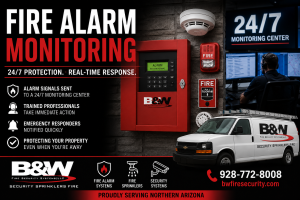
Fire Alarm Monitoring vs. Local-Only Fire Alarms: What Arizona Property Owners Should Know
A fire alarm can provide an early warning when smoke, heat or fire is detected—but who receives that warning?
That is the primary difference between a professionally monitored fire alarm system and a local-only fire alarm. A local-only system alerts people who are inside or near the building. A monitored system can also transmit signals to an off-site monitoring station, where trained operators follow an established response procedure.
For Northern Arizona businesses, commercial properties and homeowners, understanding the difference is important. The right choice can affect emergency response, property protection, insurance requirements and fire-code compliance.
In this guide, we explain fire alarm monitoring vs. local alarm systems, how each option works and what property owners should consider before choosing a system.
What Is a Local-Only Fire Alarm?
A local-only fire alarm produces an audible and, when equipped, visible warning at the protected property.
When a smoke detector, heat detector, manual pull station or other initiating device activates, the system may:
- Sound horns, bells or speakers
- Flash visual notification appliances
- Display the alarm location at the fire alarm control panel
- Activate connected building systems
- Alert occupants to evacuate
The system’s primary purpose is to warn the people who are present.
However, a local-only fire alarm does not necessarily notify an off-site monitoring station, building owner or emergency responder. Someone at the property may still need to recognize the alarm, evacuate and call 911.
That can be a serious limitation when a building is unoccupied, closed overnight or located in a rural area.
The U.S. Fire Administration emphasizes the importance of having properly installed and maintained smoke alarms. However, a smoke alarm or local fire alarm that sounds only at the property depends on someone being present to hear it and respond.
What Is a Monitored Fire Alarm System?
A monitored fire alarm system includes communication equipment that transmits signals from the protected property to an off-site supervising or monitoring station.
According to UL Solutions, a monitoring station receives alarm signals from protected properties. When an alarm is triggered, a trained operator records the signal and initiates the appropriate response.
Depending on the system’s design and programming, the monitoring station may receive:
- Fire alarm signals
- Smoke or heat detector activations
- Manual pull-station activations
- Fire sprinkler waterflow signals
- Fire sprinkler valve-tamper signals
- Supervisory signals
- Fire alarm panel trouble signals
- Communication failures
- Low-battery or power-related conditions
Monitoring therefore does more than report an active fire alarm. It can also provide information about conditions that may affect the readiness of the building’s fire protection system.
B&W Fire Security provides fire and security alarm monitoring in Northern Arizona for businesses, homes and other protected properties.
Fire Alarm Monitoring vs. Local Alarm: The Main Difference
The simplest way to compare the two systems is to consider what happens after an alarm activates.
With a local-only fire alarm, the warning generally remains at the property. Occupants hear or see the alarm and must take the appropriate action.
With a monitored fire alarm, the system produces the local warning and also transmits a signal to an off-site monitoring station.
| Feature | Local-Only Fire Alarm | Monitored Fire Alarm |
|---|---|---|
| Warns occupants inside the building | Yes | Yes |
| Activates horns and strobes | Yes, when equipped | Yes, when equipped |
| Sends signals off-site | No | Yes |
| Provides coverage while the building is empty | No | Yes |
| Reports certain trouble conditions remotely | No | Yes |
| Depends on someone being present | Generally yes | No |
| Includes an ongoing monitoring fee | No | Yes |
| May satisfy required monitoring provisions | No | Potentially, when properly designed and approved |
A monitored system does not replace the need to evacuate or call 911 during an emergency. It adds another layer of communication and oversight.
How Does Fire Alarm Monitoring Work?
The exact process depends on the fire alarm system, communication method, monitoring agreement and requirements of the local authority having jurisdiction.
In general, the following sequence occurs.
1. A Fire Alarm Device Activates
A smoke detector, heat detector, manual pull station, sprinkler waterflow switch or another approved device detects or reports a possible fire condition.
2. The Fire Alarm Panel Processes the Signal
The fire alarm control panel identifies the activated device or zone and initiates its programmed response.
The panel may display information showing where the signal originated, helping occupants and emergency personnel locate the affected area.
3. Occupants Are Warned
The system activates the building’s notification appliances, which may include:
- Horns
- Strobes
- Bells
- Speakers
- Voice-evacuation messages
Everyone inside should follow the property’s emergency procedures and evacuate when required.
Businesses should also maintain an emergency action plan. Ready.gov’s business preparedness resources can help organizations plan for emergencies, evacuation and business interruptions.
4. The Alarm Signal Is Transmitted Off-Site
The fire alarm communicator sends the signal to the monitoring station through an approved communication path.
Depending on the system and local requirements, communication may use:
- Cellular technology
- Internet protocol technology
- Radio communication
- Other approved transmission methods
Older systems may still use traditional telephone-based communication, but many property owners are replacing outdated phone-line communicators with more reliable modern options.
5. The Monitoring Station Receives the Signal
A trained monitoring-station operator receives information identifying the property and the type of signal.
The National Fire Protection Association’s explanation of supervising-station systems describes how constantly attended supervising stations receive and process signals from protected premises.
6. The Established Response Procedure Is Followed
Depending on the signal, monitoring agreement and local procedures, the operator may contact:
- Emergency responders
- The property owner
- Building management
- Designated emergency contacts
- Fire alarm service personnel
The system should still be evaluated after an activation. A fire alarm should only be reset after the cause has been identified and the building has been determined to be safe.
What Happens With a Local-Only Fire Alarm?
A local-only system may successfully detect a fire and warn everyone inside the building. When trained occupants are present, that warning can give people valuable time to evacuate and call 911.
The concern arises when no one is there to hear it.
Consider a fire that begins:
- After a business has closed
- Overnight in an unoccupied office
- Inside a vacant rental property
- During a holiday shutdown
- In a detached or rarely occupied building
- While a homeowner is away
- In an isolated area of a warehouse
- In a noisy industrial environment where the alarm is not immediately recognized
A local-only alarm could continue sounding without anyone taking action.
A professionally monitored system can transmit a signal even when the property is empty.
Why Fire Alarm Monitoring Matters When a Building Is Empty
Many commercial properties are unoccupied for a significant portion of every day.
An office may close at 5:00 p.m. A retail business may be empty overnight. A warehouse may have only a few employees working in limited areas. Vacation homes and rental properties may remain unoccupied for days or weeks.
A local warning is only useful when someone is close enough to hear or see it.
Fire alarm monitoring provides off-site signal supervision regardless of whether the building is occupied.
This can be especially important for Northern Arizona properties because of:
- Rural locations
- Seasonal occupancy
- Winter weather
- Power interruptions
- Internet or telephone outages
- Long distances between properties
- Vacation homes and short-term rentals
- Businesses that close overnight
- Properties surrounded by vegetation
Monitoring cannot prevent every fire or guarantee a specific emergency-response time. However, it can help ensure that an alarm signal is not limited to an empty building.
For more information about local commercial protection options, visit B&W Fire Security’s business fire alarm and safety services page.
Alarm, Supervisory and Trouble Signals
One important advantage of fire alarm monitoring is the ability to distinguish between different types of system signals.
Alarm Signal
An alarm signal indicates an emergency condition, such as:
- Smoke detection
- Heat detection
- Manual pull-station activation
- Fire sprinkler waterflow
- Another programmed fire condition
This is the signal most people associate with a fire alarm.
Supervisory Signal
A supervisory signal indicates that part of a fire protection system may be in an abnormal condition.
For example, a sprinkler control valve that has been moved away from its normal position may activate a tamper switch and generate a supervisory signal.
A supervisory signal does not necessarily mean there is an active fire, but it should not be ignored. It may indicate that part of the building’s fire protection system has been altered, disabled or impaired.
Learn more about this type of device in our guide to the fire sprinkler tamper switch.
Trouble Signal
A trouble signal indicates a problem with the fire alarm system itself.
Common causes may include:
- Loss of primary power
- Low backup batteries
- Damaged wiring
- Communication failures
- Device faults
- Ground faults
- Notification-circuit problems
- Failed or disconnected equipment
Trouble signals require attention because they may affect the system’s ability to detect a fire, notify occupants or transmit signals correctly.
Professionally monitored systems can transmit these conditions off-site, helping property representatives learn about problems even when no one is standing near the fire alarm panel.
The NFPA provides additional information about the functions and supervision of fire alarm systems in its Guide to Fire Alarm Basics: Supervision.
Does a Monitored Fire Alarm Automatically Contact the Fire Department?
A monitored fire alarm system transmits programmed signals to a supervising station. The monitoring station then follows the response procedures established for that property and signal type.
Property owners should not assume that every signal receives the same response.
An alarm signal, supervisory signal and trouble signal represent different conditions. The response may also depend on:
- Local fire-department procedures
- The monitoring agreement
- The type of property
- Fire alarm panel programming
- Authority-having-jurisdiction requirements
- Current emergency contact information
- Whether the alarm can be verified
- The type of device that activated
Property owners should review their monitoring procedures and keep their emergency contact list current.
During an actual emergency, occupants should evacuate and call 911 from a safe location. Never remain inside a dangerous building because you assume the monitoring station has already handled everything.
Is Fire Alarm Monitoring Required?
Fire alarm monitoring requirements are not identical for every building.
Whether monitoring is required may depend on:
- Building occupancy
- Building size
- Fire alarm system type
- Fire sprinkler system configuration
- Applicable fire and building codes
- Local amendments
- Insurance requirements
- Approved construction plans
- Permit requirements
- The authority having jurisdiction
NFPA 72, National Fire Alarm and Signaling Code, includes provisions related to fire detection, notification, emergency communications and supervising-station alarm systems.
However, property owners should not try to determine compliance from a general online article alone.
The applicable code edition and local requirements may vary between Prescott, Prescott Valley, Chino Valley, Flagstaff, Sedona, Camp Verde and other Northern Arizona jurisdictions.
The local fire marshal, building department or other authority having jurisdiction makes the final determination.
A qualified fire alarm company can evaluate the system, review available documentation and help determine what additional information or approvals may be required.
Property managers can also review our Northern Arizona fire inspection requirements guide for more information about inspections and code compliance.
Advantages of Professionally Monitored Fire Alarms
Protection When No One Is Present
A monitored system can transmit signals when the building is empty, closed or unattended.
This is one of its most important advantages over a local-only alarm.
Remote Reporting of System Conditions
Depending on the system’s design, monitoring may report:
- Fire alarms
- Sprinkler waterflow
- Valve-tamper conditions
- Supervisory conditions
- Panel trouble conditions
- Power failures
- Communication failures
Faster Awareness of an Alarm
Property owners and designated contacts do not have to wait for a neighbor, employee or passerby to notice the local alarm.
Centralized Signal Records
Monitoring systems can create records of received signals and operator activity.
These records may help when:
- Investigating an activation
- Confirming the time a signal was received
- Reviewing recurring trouble conditions
- Documenting system events
- Coordinating repairs
Added Protection for Rural and Seasonal Properties
Northern Arizona contains many rural, seasonal and intermittently occupied properties. Off-site monitoring can be especially valuable in these situations.
Support for Code or Insurance Requirements
Monitoring may be required by:
- The applicable fire code
- Approved building plans
- The local authority having jurisdiction
- A lease agreement
- A lender
- An insurance carrier
Property owners should verify the requirements that apply to their specific building.
Limitations of Local-Only Fire Alarms
Local-only fire alarms can provide valuable occupant notification, but property owners should understand their limitations.
Someone Must Be Present
If no one can hear or see the warning, the alarm may not result in an immediate response.
System Problems May Go Unnoticed
A trouble signal at the fire alarm panel may continue until someone visits the property and notices it.
There Is No Off-Site Signal Transmission
A local-only alarm does not automatically provide information to a monitoring station.
The System Depends More Heavily on Occupant Action
Employees, tenants or visitors must:
- Recognize the alarm
- Evacuate
- Call 911
- Notify property management
- Prevent unauthorized resetting of the system
It May Not Meet the Building’s Requirements
A local-only system may not satisfy the requirements for certain commercial buildings, occupancies, sprinkler systems or approved fire protection plans.
Are There Disadvantages to Fire Alarm Monitoring?
Fire alarm monitoring provides significant benefits, but it also comes with responsibilities.
Ongoing Monitoring Costs
Professional monitoring normally includes a recurring service fee.
Communication Equipment Must Be Maintained
The communicator, backup power and transmission path must remain functional.
A communication failure should be investigated promptly because the fire alarm may still operate locally while being unable to transmit signals off-site.
Emergency Contact Information Must Be Updated
Outdated names and phone numbers can create delays and confusion during an alarm or trouble condition.
Property owners should review their emergency contacts whenever there is:
- An employee change
- A management change
- A new property owner
- A new tenant
- A changed phone number
- A change in after-hours responsibility
Unwanted Alarms Must Be Corrected
Monitoring does not correct dirty detectors, damaged wiring, improper system use or neglected maintenance.
Recurring unwanted alarms should be investigated by qualified fire alarm personnel.
Monitoring Does Not Replace Inspections
A monitored system still requires applicable inspection, testing and maintenance.
Monitoring and inspection perform different functions:
- Monitoring receives and processes signals throughout the monitoring period.
- Inspection and testing evaluate whether the equipment and system functions operate properly.
B&W Fire Security provides professional fire alarm and sprinkler inspections to help Northern Arizona businesses keep their systems operational and inspection-ready.
Can an Existing Local Fire Alarm Be Upgraded?
In many cases, an existing local fire alarm system can be evaluated for the addition of professional monitoring.
An upgrade may require:
- A compatible fire alarm communicator
- Cellular or another approved communication path
- Fire alarm panel programming
- Additional power supplies
- New backup batteries
- Monitoring account setup
- Updated system documentation
- Permits or approval
- Testing with the monitoring station
- Final acceptance by the authority having jurisdiction
Not every older fire alarm panel can be upgraded easily.
Some systems are obsolete, have limited programming capabilities or no longer have compatible replacement parts available.
A professional assessment can determine whether adding monitoring is practical or whether a broader system replacement would provide better long-term value.
B&W Fire Security’s business fire alarm services include system design, installation, testing, monitoring, upgrades and ongoing maintenance.
Cellular Fire Alarm Monitoring vs. Traditional Phone Lines
Many older fire alarm systems were designed to transmit signals using traditional telephone lines.
As communication technology changes, property owners may find that older telephone-based systems are becoming less practical or reliable.
Cellular fire alarm communicators may offer several advantages:
- No dependence on traditional copper phone lines
- Dedicated alarm communication
- Faster installation in some buildings
- Compatibility with many existing fire alarm panels
- Supervision of the communication path
- Reduced risk of a disconnected phone line going unnoticed
However, cellular monitoring equipment must still be:
- Compatible with the fire alarm panel
- Properly installed
- Correctly programmed
- Provided with appropriate backup power
- Tested with the monitoring station
- Approved when required
A cellular communicator should not be treated like an ordinary consumer mobile device. It is part of the building’s life-safety system and should be installed and serviced by qualified professionals.
Fire Alarm Monitoring vs. Smartphone Notifications
Some modern alarm and smart-building systems can send notifications to a mobile app.
These alerts can be useful, but an app notification is not necessarily the same as approved professional fire alarm monitoring.
A smartphone may be:
- Turned off
- On silent mode
- Outside cellular coverage
- Disconnected from the internet
- Left unattended
- Logged out of the application
- Used by an employee who is no longer responsible for the building
Professional supervising-station monitoring provides a constantly attended location for receiving signals.
Mobile alerts may supplement monitoring, but they should not be assumed to replace code-required supervising-station service.
Fire Alarm Monitoring and Fire Sprinkler Systems
Fire alarm monitoring frequently works together with a building’s fire sprinkler system.
A monitored fire alarm panel may receive signals from:
- Waterflow switches
- Valve-tamper switches
- Low-air-pressure switches
- Fire pumps
- Special suppression systems
- Other connected supervisory devices
For example, when a sprinkler activates, water movement may trigger a waterflow switch. The fire alarm system can then:
- Activate the building’s fire alarm notification appliances.
- Display the waterflow condition at the panel.
- Transmit an alarm signal to the monitoring station.
If a sprinkler control valve is partially closed, the valve’s tamper switch may generate a supervisory signal.
Learn more about commercial sprinkler protection on our business fire sprinkler systems page.
How to Choose Between a Monitored and Local-Only Fire Alarm
Ask the following questions before making a decision:
- Is monitoring required by the applicable fire code or approved plans?
- Is the property occupied around the clock?
- Who would hear the alarm after business hours?
- How quickly would someone notice a trouble signal?
- Does the building have a fire sprinkler system that requires supervision?
- Is the property in a rural or seasonal location?
- What does the insurance carrier require?
- Is the existing fire alarm panel capable of reliable communication?
- Are emergency contacts available at all times?
- Who will inspect, test and maintain the system?
- Is the current communication method becoming obsolete?
- Has the system experienced repeated communication failures?
For most commercial properties, the decision should begin with applicable code requirements and an evaluation by a qualified fire alarm professional—not price alone.
Fire Alarm Monitoring for Northern Arizona Properties
Northern Arizona properties have unique fire protection needs.
Businesses and homeowners may face:
- Rural locations
- Cold winter conditions
- Seasonal occupancy
- Utility interruptions
- Properties that remain vacant overnight
- Large service areas
- Wildfire exposure
- Limited on-site staffing
B&W Fire Security Systems provides professional fire alarm services throughout Northern Arizona, including Prescott, Prescott Valley, Chino Valley, Flagstaff, Sedona, Camp Verde and surrounding communities.
Our services include:
- Fire alarm installation
- Fire alarm monitoring
- Fire alarm inspections and testing
- Fire alarm system upgrades
- Cellular communicator installation
- Fire sprinkler monitoring
- Fire alarm troubleshooting
- System repairs
- Commercial fire protection services
Explore all our Northern Arizona service locations or visit our Prescott fire protection services page for local information.
Frequently Asked Questions
Will a Local Fire Alarm Contact the Fire Department?
Generally, a local-only fire alarm warns occupants at the property but does not transmit a signal to an off-site monitoring station.
Someone may need to evacuate and call 911.
The exact system arrangement should be verified by reviewing the system documentation or consulting a qualified fire alarm professional.
Does a Monitored Fire Alarm Work When the Building Is Empty?
Yes, provided the fire alarm system, communicator and communication path are operating correctly.
The system can transmit programmed signals to the monitoring station even when no occupants are present.
Can Fire Alarm Monitoring Detect a Closed Sprinkler Valve?
When the sprinkler valve is equipped with an appropriate tamper switch and connected to the monitored fire alarm system, movement away from its normal position may generate a supervisory signal.
The exact point at which the signal activates depends on the equipment and installation.
What Is the Difference Between Fire Alarm Monitoring and a Fire Alarm Inspection?
Monitoring provides ongoing off-site reception and processing of programmed system signals.
An inspection is a scheduled evaluation and testing of the fire alarm equipment and system functions.
A monitored system still needs applicable inspections, testing and maintenance.
Does Fire Alarm Monitoring Guarantee That Firefighters Will Arrive Immediately?
No company should guarantee an exact emergency-response time.
Signal transmission, processing, local procedures, weather, road conditions and emergency-resource availability can all affect the response.
Occupants should evacuate and call 911 from a safe location during an emergency.
Can I Use an App Instead of Professional Fire Alarm Monitoring?
Mobile notifications may provide useful supplemental information, but they are not necessarily equivalent to approved supervising-station monitoring.
Required fire alarm monitoring should be designed and provided according to the applicable codes, approved plans and local requirements.
How Much Does Fire Alarm Monitoring Cost?
The cost depends on:
- The existing fire alarm system
- Communication equipment
- Property type
- Required signal types
- Monitoring services included
- Whether new equipment must be installed
- Whether permits or upgrades are needed
An older system may require a communicator or panel upgrade before professional monitoring can be established.
How Often Should a Monitored Fire Alarm Be Tested?
Inspection and testing frequency depends on the equipment, system type, applicable code and local requirements.
Professional testing should include verification that required signals are correctly received by the monitoring station.
What Should I Do if My Fire Alarm Panel Shows a Communication Failure?
Contact your fire alarm service provider promptly.
A communication failure may mean the fire alarm still sounds locally but cannot transmit signals to the monitoring station.
Do not silence or reset recurring trouble conditions without determining and correcting their cause.
Protect Your Property With Professional Fire Alarm Monitoring
A local fire alarm can warn people inside a building, but its effectiveness may be limited when the property is empty.
Professional fire alarm monitoring adds off-site signal communication, providing another layer of protection for businesses, commercial facilities and homes throughout Northern Arizona.
The right solution depends on your building, existing equipment, occupancy, approved plans and local requirements.
For help evaluating your current fire alarm system, adding cellular monitoring or determining whether an older panel can be upgraded, contact B&W Fire Security Systems.
Call B&W Fire Security Systems at 928-772-8008 to schedule a fire alarm monitoring evaluation in Northern Arizona.
This article provides general educational information and is not a substitute for an evaluation of your property, approved construction documents, applicable codes or instructions from the authority having jurisdiction.